What Happens When You Stop Taking Mounjaro
 Medically reviewed by Ashis Tandukar (Pharmacist · Reg: GPhC No. 2084170)
In this article
- Why does weight come back after stopping Mounjaro?
- What the clinical evidence actually shows
- The cardiovascular question most people miss
- A realistic week-by-week timeline
- Weeks 1–2: The quiet before the shift
- Weeks 3–4: Appetite returns
- Weeks 5–12: The adjustment period
- Months 3–12: The new equilibrium
- How to keep weight off after stopping Mounjaro
- Prioritise protein like your metabolism depends on it (because it does)
- Strength training
- Manage the food noise consciously
- Monitor without obsessing
- Stopping Mounjaro vs stopping Wegovy: is there a difference?
- When a maintenance dose might make more sense than stopping
- Can you stop Mounjaro cold turkey?
- The emotional side of stopping
- What about restarting Mounjaro later?
- The bottom line
- Frequently asked questions
- Do you gain weight back after stopping Mounjaro?
- Can you stop Mounjaro cold turkey?
- How long does Mounjaro stay in your system after stopping?
- Can I stop Mounjaro for 2 weeks and restart?
- How to keep weight off after stopping Mounjaro?
If you've been on Mounjaro and you're thinking about coming off it, that knot of anxiety in your stomach is completely normal. Most people we speak to say the same thing: the treatment worked, they feel better than they have in years, and now they're terrified of losing all of it.
Here's the honest answer: yes, your body will change when you stop tirzepatide. But "change" doesn't have to mean "back to square one." What happens next depends far more on what you do in the weeks and months after stopping than most people realise.
At a glance
- Most people experience some weight regain after stopping Mounjaro — clinical data shows an average of 14% regain within 12 months
- Appetite and food noise typically return within 2–4 weeks as tirzepatide leaves your system
- The SURMOUNT-4 trial found that 82% of participants regained at least a quarter of their lost weight after discontinuation
- A structured plan — including strength training, protein-focused nutrition, and gradual tapering — can significantly limit regain
- Some people may benefit from a long-term maintenance dose rather than stopping completely
- Stopping Mounjaro is medically safe and does not require a tapering protocol, though many clinicians recommend one
Why does weight come back after stopping Mounjaro?
Mounjaro (tirzepatide) works by mimicking two gut hormones — GLP-1 and GIP — that regulate appetite, blood sugar, and how your body stores fat. While you're taking it, these hormones are being supplemented at levels far higher than your body produces naturally. Your brain receives stronger "I'm full" signals. Your stomach empties more slowly. That relentless background hum of thinking about food — what clinicians call "food noise" — goes quiet. For a deeper look at this mechanism, our guide on how Mounjaro affects hormones and hunger explains the science in more detail.
When you stop, those supplemented hormone levels drop back to your body's baseline within about 2–3 weeks. And your brain notices.
What many people don't realise is that weight loss itself triggers a set of biological responses designed to push your weight back up. Your body interprets significant weight loss as a potential threat and responds by:
- Increasing levels of ghrelin (the hunger hormone)
- Reducing leptin (the satiety hormone)
- Lowering your resting metabolic rate by roughly 10–15% beyond what the weight loss alone would account for
This is called metabolic adaptation, and it happens regardless of how you lost the weight. Mounjaro was overriding these signals. Without it, they return.
What the clinical evidence actually shows
The most important study here is SURMOUNT-4, published in 2023. Researchers took participants who had lost weight on tirzepatide for 36 weeks, then randomly assigned half to continue treatment and half to switch to placebo.
The results were stark. Over the following 52 weeks:
- The group that continued Mounjaro lost an additional 5.5% of their body weight
- The group that stopped regained an average of 14% — roughly two-thirds of what they'd originally lost
- 82% of those who stopped regained at least a quarter of their lost weight
- Around 24% regained 75–100% of what they'd lost
These numbers aren't meant to frighten you. They're meant to set realistic expectations. The majority of people will experience meaningful regain. But a significant proportion — nearly 1 in 5 — kept most of their weight off even without continued treatment.
What separated those who maintained from those who didn't? The study didn't fully answer that question, but the clinical pattern we see at heySlim points clearly towards preparation: people who had built sustainable habits while on treatment fared far better than those who relied on the medication alone.
The cardiovascular question most people miss
One angle that rarely gets discussed in weight loss conversations: the SURMOUNT-4 trial also tracked cardiovascular markers. Participants who stopped Mounjaro saw improvements in blood pressure, cholesterol, and inflammatory markers begin to reverse — not immediately, but measurably over 12 months.
The British Heart Foundation has highlighted this as an important consideration. If you started Mounjaro partly because of cardiovascular risk, stopping isn't just about the number on the scale. It's worth having a conversation with your prescriber about whether your heart health markers have shifted enough to sustain off treatment, or whether a maintenance approach makes more sense.
A realistic week-by-week timeline
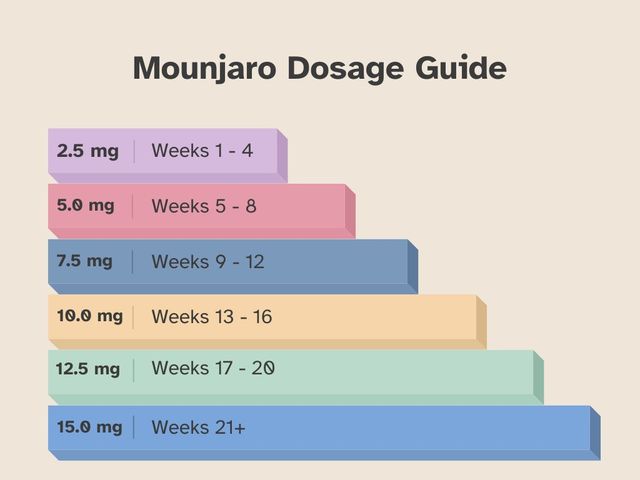
Everyone's experience differs, but here's what most people report. This isn't a clinical protocol — it's a composite of what we hear from patients and what the pharmacology predicts. If you're unsure about your current dose and how to step down, our Mounjaro dosage guide covers each dose level in detail.
Weeks 1–2: The quiet before the shift
Tirzepatide has a half-life of about 5 days, so it takes roughly 25 days to leave your system entirely. In the first two weeks, most people feel relatively normal. You might notice slightly more interest in food, but nothing dramatic. This is the best time to solidify routines — meal prep, exercise schedules, protein targets — while you still have the medication's support.
Weeks 3–4: Appetite returns
This is when most people notice a real change. The food noise comes back. You might find yourself thinking about meals hours in advance, snacking when you hadn't been, or noticing cravings for specific foods — often carb-heavy or sweet. Portions start creeping up.
This is your GLP-1 and GIP levels returning to their pre-treatment baseline. Knowing this is coming — and having a plan for it — makes an enormous difference.
Weeks 5–12: The adjustment period
Your body is recalibrating. Metabolic rate may dip slightly as the thermic effects of tirzepatide wear off. Some people experience a period of digestive adjustment — faster gastric emptying can mean you feel hungry sooner after eating than you've been used to.
Weight regain, if it's going to happen, typically accelerates during this window. The average is about 1–2 kg per month, though individual variation is substantial.
Months 3–12: The new equilibrium
By three months, most of the acute adjustment is over. Your weight will likely have settled somewhere between your lowest treatment weight and your pre-treatment weight. Where exactly depends heavily on what habits you've maintained.
The encouraging finding from clinical data: for people who maintain structured exercise and dietary habits, the regain curve tends to flatten significantly after the 3–4 month mark.
How to keep weight off after stopping Mounjaro
Prioritise protein like your metabolism depends on it (because it does)
When you're losing weight — and especially after stopping a GLP-1 medication — muscle mass is vulnerable. And muscle is metabolically expensive tissue. Every kilogram of muscle you lose reduces your daily calorie burn, making regain more likely.
Aim for 1.2–1.6g of protein per kilogram of your target body weight daily. For most people, that means 80–120g per day.
Practical targets:
- Breakfast: 25–30g (Greek yoghurt with nuts, or eggs with smoked salmon)
- Lunch: 30–35g (chicken or prawn salad, lentil soup with bread)
- Dinner: 30–35g (fish, lean meat, tofu, or legumes as the anchor)
- Snacks: 10–15g (cottage cheese, edamame, protein-rich options)
Strength training
Cardio has its place, but resistance training is the single most effective tool for preserving muscle mass and maintaining metabolic rate after weight loss. Two to three sessions per week is enough. For more on this, we've written a detailed guide on maintaining muscle while on GLP-1 medications — the same principles apply after stopping.
You don't need a gym membership. Bodyweight exercises, resistance bands, or a pair of dumbbells at home will do the job. The key is progressive overload — gradually increasing the challenge over time, whether that's more weight, more reps, or more difficult variations.
If you haven't done strength training before, this is worth investing in a few sessions with a qualified personal trainer to get the basics right. Poor form leads to injury; injury leads to inactivity; inactivity accelerates regain.
Manage the food noise consciously
When appetite returns, the biggest risk isn't hunger itself — it's the unplanned eating that comes from not having a strategy. What helped while you were on Mounjaro (smaller portions felt natural, snacking dropped off automatically) now needs to be managed actively.
Some approaches that patients find helpful:
- Volume eating: Filling half your plate with vegetables and salad. The fibre and water content help with satiety even without GLP-1 support.
- Meal planning: Not rigid calorie counting, but knowing what you're eating for the day. Eliminates the "what should I have?" decisions that often end in takeaways.
- Mindful pauses: Before eating outside planned meals, wait 15 minutes. Genuine hunger persists; impulse cravings often pass.
Monitor without obsessing
Weigh yourself once a week, same day, same time, same conditions. Weight fluctuates by 1–2 kg daily due to water, food, and hormones — daily weigh-ins create noise that obscures the actual trend.
If you see a sustained upward trend of more than 2–3 kg over a month, that's a signal to review your plan. Catching regain early gives you options.
Stopping Mounjaro vs stopping Wegovy: is there a difference?
This is a question we get frequently, and the honest answer is: probably, though the data isn't directly comparable. If you're weighing up your options, our guide on switching from Mounjaro to Wegovy covers the clinical differences between the two.
Mounjaro targets two receptors (GLP-1 and GIP), while Wegovy (semaglutide) targets only GLP-1. The dual mechanism appears to produce greater initial weight loss — the SURMOUNT trials showed average losses of 20–25% of body weight compared to 15–17% in Wegovy's STEP trials.
What's less clear is whether the regain pattern differs. The STEP 1 trial extension showed similar proportional regain after stopping semaglutide — roughly two-thirds of lost weight over 12 months. The dual-agonist mechanism of tirzepatide might theoretically offer a slightly different metabolic trajectory, but we don't yet have head-to-head discontinuation data.
For practical purposes, the approach to maintaining weight after stopping either medication is essentially the same: protect muscle, manage appetite actively, and have a monitoring plan.
When a maintenance dose might make more sense than stopping
Not everyone needs to stop completely. There's growing clinical consensus that for some people — particularly those with a higher starting BMI, significant metabolic comorbidities, or a history of repeated weight cycling — a long-term low maintenance dose may be more appropriate than full discontinuation.
This isn't failure. Obesity is increasingly understood as a chronic condition with strong biological drivers. Treating it with ongoing medication is no different from taking statins for cholesterol or antihypertensives for blood pressure.
A maintenance dose typically means stepping down to the lowest effective dose — often 2.5mg or 5mg of tirzepatide — rather than continuing at the full therapeutic dose. This can help:
- Dampen appetite enough to support maintenance without full suppression
- Reduce the cost of continued treatment
- Minimise side effects while preserving some metabolic benefit
Discuss this with your prescriber. It's a perfectly valid clinical decision, not a consolation prize.
Can you stop Mounjaro cold turkey?
Yes. Unlike some medications (certain antidepressants, benzodiazepines, corticosteroids), tirzepatide has no withdrawal syndrome and no medical requirement to taper. You can take your last injection and simply stop.
That said, many clinicians — ourselves included — recommend a gradual step-down where possible. Not because of withdrawal risk, but because it gives your body (and your habits) time to adjust. Dropping from 15mg to nothing overnight is a bigger shock to your appetite regulation than stepping down through 10mg, then 7.5mg, then 5mg over a few months.
If your prescription is ending due to cost or a clinical decision, and tapering isn't possible, don't worry. Abrupt discontinuation is medically safe. Just be prepared for the appetite changes to arrive more suddenly.
The emotional side of stopping
Something that clinical trials don't capture well: stopping Mounjaro can feel like a loss. For many people, the medication represented the first time in years — sometimes decades — that food didn't dominate their thinking. The relief of that mental quiet is profound.
When it ends, you might feel frustrated, anxious, or angry — at the situation, at your body, at the cost of medication. You might feel like you're being sent back into a battle you'd finally found a way out of.
These feelings are valid. They're also normal. And they don't mean you're going to end up back where you started.
What we find matters most during this transition: having a plan you trust, realistic expectations about what comes next, and — crucially — not interpreting every fluctuation or craving as evidence of inevitable failure.
Some people benefit from speaking with a psychologist or counsellor who specialises in weight management during this transition. If food and body image have been sources of distress, professional support should be part of the treatment plan.
What about restarting Mounjaro later?
If you stop and find that weight regain is significant despite best efforts, restarting is an option. Tirzepatide works just as effectively on a second course of treatment. You won't have "used up" its benefits.
However, you'll typically need to restart at a lower dose and titrate back up, which means the initial weeks of side effects may return. It's also worth noting that each restart involves cost — both financial and in terms of the adjustment period.
The decision framework we suggest:
- If regain is modest (under 5 kg) and stabilising: Continue with lifestyle measures, monitor monthly
- If regain is significant (5–10+ kg) and ongoing: Discuss restarting or a maintenance dose with your prescriber
- If metabolic markers are worsening (blood sugar, blood pressure, cholesterol rising): Restarting may be clinically indicated regardless of the number on the scale
The bottom line
Coming off Mounjaro is a significant transition, and it deserves proper planning. The biological reality is that most people will experience some weight regain, but the degree varies enormously based on preparation.
Build habits while you still have pharmaceutical support. Prioritise protein and strength training. Have a monitoring plan. And know that if you need to restart or move to a maintenance dose, that's a clinical decision — not a personal failing.
Frequently asked questions
Do you gain weight back after stopping Mounjaro?
Most people experience some weight regain after discontinuing Mounjaro. The SURMOUNT-4 trial showed an average regain of about 14% of body weight over 12 months — roughly two-thirds of the weight originally lost. However, nearly 1 in 5 participants maintained most of their weight loss, typically those who had established strong exercise and nutrition habits during treatment.
Can you stop Mounjaro cold turkey?
Yes. Tirzepatide has no withdrawal syndrome and stopping abruptly is medically safe. However, many clinicians recommend a gradual dose reduction where possible — not for safety reasons, but to give your appetite regulation time to adjust more gradually. If abrupt stopping is necessary, it won't cause harm, but expect appetite changes within 2–4 weeks.
How long does Mounjaro stay in your system after stopping?
Tirzepatide has a half-life of approximately 5 days, meaning it takes around 25 days (five half-lives) to be essentially eliminated from your body. Most people notice appetite changes returning between weeks 2 and 4 after their last injection.
Can I stop Mounjaro for 2 weeks and restart?
A short break of 1–2 weeks is unlikely to cause significant issues, as the medication will still be partially active in your system. However, if you stop for longer than 4 weeks, your prescriber may recommend restarting at a lower dose and titrating back up to reduce the risk of gastrointestinal side effects.
How to keep weight off after stopping Mounjaro?
Focus on three pillars: adequate protein intake (1.2–1.6g per kg of target body weight daily), regular strength training (2–3 sessions per week to preserve muscle mass), and active appetite management through meal planning and mindful eating. Weekly weight monitoring helps catch any regain trend early, giving you time to adjust before it becomes significant.
This article is for informational purposes only and does not constitute medical advice. Always consult with a qualified healthcare professional before starting any treatment.