Mounjaro Before and After: 3 UK Patient Stories
 Medically reviewed by Ashis Tandukar (Pharmacist · Reg: GPhC No. 2084170)
In this article
- What Mounjaro is, briefly
- Story 1: Hannah*, 38 — "I'd done every diet"
- Story 2: Priya*, 42 — Quieting the food noise
- Story 3: Marcus*, 32 — Past the fear of the needle
- What these three stories have in common
- What you can realistically expect on Mounjaro
- A note on the photos you see online
- The role of lifestyle alongside the medication
- Frequently asked questions
The "after" photo gets all the attention. The "before" rarely does. But what the cameras miss — and what most people only realise once they're well into their treatment — is everything sitting in between. The food obsession that quietly fades. The energy that creeps back. The clothes that surprise you in the changing room.
This piece isn't about scale numbers or transformation montages. It's three stories from people who came to a UK weight-loss service much like ours, started Mounjaro, and noticed the changes that actually mattered to them.
At a glance
- Most people on Mounjaro lose 15–22% of their body weight over 12–18 months when they pair the medication with sustainable habits
- The first noticeable change is usually the quietness — that constant background noise about food settling down
- Visible weight loss tends to start around weeks 4–6, with steady progress through months 3–6
- Side effects (nausea, tiredness, constipation) are most common in the first weeks and usually settle as your body adjusts
- Real-life results depend on starting dose, titration speed, lifestyle changes and individual biology — not on a fixed timeline
What Mounjaro is, briefly
Mounjaro (tirzepatide) is a once-weekly injection licensed in the UK for chronic weight management. It mimics two natural gut hormones — GLP-1 and GIP — that help regulate appetite, slow stomach emptying and improve how your body handles blood sugar. The dual action is what makes it more effective than older single-hormone treatments like Wegovy.
If you want the full mechanism, we've covered how Mounjaro affects hormones, hunger and the brain in a separate piece. For this article, the more useful thing is to look at what the experience actually feels like for the people taking it.
Story 1: Hannah*, 38 — "I'd done every diet"

Hannah came to us at 96kg, looking for something different. She'd done Slimming World twice, lost the weight, regained it. Tried 16:8 fasting. Spent four months on a keto plan that worked beautifully — until it didn't. By the time she booked her consultation, she was tired of the cycle and quietly worried about her blood pressure.
Four months in on Mounjaro, she'd lost 14kg.
What surprised her wasn't the weight loss. It was the feeling of not having to fight herself. "The diet voice in my head — the one constantly negotiating about what I could and couldn't eat — just got quieter," she told us. "I didn't realise how exhausting that voice was until it stopped."
Hannah started on the 2.5mg dose for the first month, moved up to 5mg, then 7.5mg by month four. She had nausea for about ten days at each dose increase, which settled when she ate more slowly and stuck to plain, lower-fat foods. By the four-month mark she was walking 30 minutes most days and batch-cooking at the weekends — small habits that came naturally once the food obsession faded.
If the constant chatter about food sounds familiar, we go into it in more depth in food noise explained.
Story 2: Priya*, 42 — Quieting the food noise
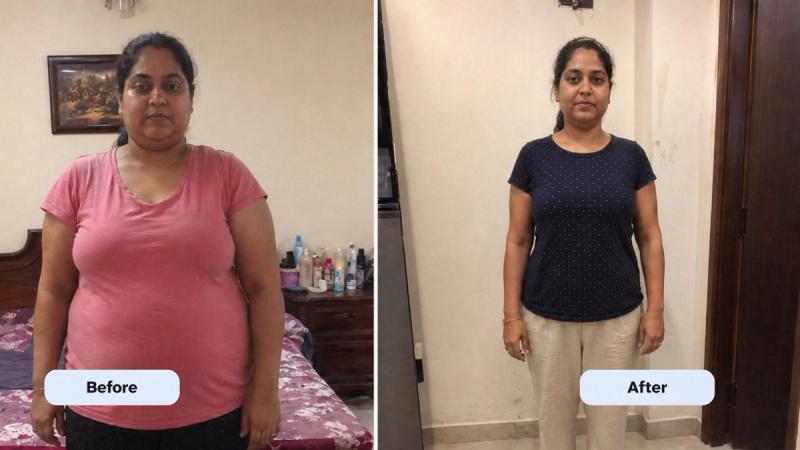
Priya didn't think of herself as someone who overate. She wasn't bingeing. She wasn't grazing all day. But she was constantly thinking about food — what was for dinner, what she'd packed for the kids, whether to snack now or wait until later, what she'd cook for the weekend. It was background noise that never switched off.
Six months on Mounjaro, she'd lost 18kg. But the change she talks about isn't the weight — it's the silence.
"For the first time in years, I sat down at my desk in the morning and just worked. I didn't think about lunch until I got hungry. That's never happened before."
Her treatment wasn't smooth. The first month brought significant fatigue and some constipation, both of which improved when she upped her water intake — we'd suggest aiming for at least 2 litres daily, and we go into the detail in how much water to drink on Mounjaro. She also struggled with sulfur burps for a couple of weeks, which can be unpleasant but tend to pass.
What helped Priya most wasn't a particular tip. It was knowing what to expect. We'd talked through the common Mounjaro headaches and side effects before she started, so when nausea hit on day five, it didn't catch her off guard.
Story 3: Marcus*, 32 — Past the fear of the needle

Marcus delayed booking his consultation for nearly a year. Not because he wasn't sure about Mounjaro — he'd done his research — but because he genuinely couldn't face the idea of injecting himself. He'd watched videos on YouTube and convinced himself it wouldn't be for him.
6 months later he'd lost 30kg, and had become, in his own words, "weirdly evangelical about how easy the injection is."
The pen, like most modern weight-loss injectors, uses a needle so fine you barely feel it. We walked Marcus through where to inject — rotating between thigh, abdomen and upper arm, all covered in our where to inject Mounjaro guide — and what to expect from the click of the pen.
His weight loss was steady but not dramatic. Around 3-4kg a month. What changed his life wasn't the number on the scale, it was the knee pain that had bothered him for five years. By month three, he was climbing the stairs at his office without thinking about it. He started cycling on Sundays. Then twice a week.
What these three stories have in common
Three different people. Three different starting weights. Three different reasons for finally trying medication. And yet, when we look back through patient notes, the same patterns turn up over and over.
The food noise quietens before the weight visibly drops. Almost everyone tells us this at the four-week check-in — they aren't sure they've lost any weight yet, but they feel different around food. That cognitive shift is often the first real sign Mounjaro is working.
Side effects are predictable but manageable. Nausea, tiredness, constipation, occasional headaches — these come up most in the first few weeks and again at each dose increase. The patients who weather them best are the ones who eat smaller, blander meals, hydrate properly, and don't rush their titration.
Lifestyle changes happen as a side-effect of the medication, not as a separate effort. When you're not constantly thinking about food, walking that extra 20 minutes feels easier. Meal-prepping feels less like punishment. The medication doesn't replace the habits — it makes them possible.
What you can realistically expect on Mounjaro
The headline number from clinical trials is striking: people on the highest tirzepatide doses lost an average of 22.5% of their body weight over 72 weeks in the SURMOUNT-1 trial. That's around 23kg for someone starting at 100kg.
But averages hide the real picture. Some people lose more. Some lose less. Some respond beautifully on the lowest dose. Others need to titrate to 12.5mg or 15mg to see meaningful change.
Roughly speaking, here's the timeline most patients experience:
- Weeks 1–4 (2.5mg starting dose): Food noise quietens. You might lose 1–3kg, but visible change is minimal. Side effects, if you get them, are most likely now.
- Weeks 5–12 (titrating up to 5mg, then 7.5mg): Steady weight loss begins. Most people lose 4–8kg in this window. Clothes start fitting differently.
- Months 3–6: The biggest visible change. Average loss is around 10–15% of starting body weight. This is when before-and-after photos genuinely diverge.
- Months 6–12+: Continued loss for most people, then a natural plateau. Maintenance becomes the focus.
If you want a more granular picture of what week-to-week looks like, we've broken it down in Mounjaro weight loss in a month.
A note on the photos you see online
A quick word of caution. The dramatic before-and-after photos circulating on social media — the ones that make Mounjaro look like a magic wand — usually leave out important context. The starting weight. The timeframe. The lifestyle changes. Sometimes other procedures.
Real Mounjaro results are quieter. Less Instagrammable. Most people don't post photos of "the day my knee stopped hurting" or "the week I stopped thinking about food." Those are the changes that tend to matter most.
It's also worth knowing that weight loss of this scale can leave some people with looser skin, particularly across the abdomen and upper arms. There's plenty you can do to support skin elasticity as you lose weight — we cover the practical side in how to prevent loose skin during weight loss.
The role of lifestyle alongside the medication
Mounjaro on its own will produce weight loss — that's well established. But the patients who keep the weight off long-term are the ones who use the medication as scaffolding for sustainable habits, not as a replacement for them.
A few things consistently help. A modest protein focus at each meal — typically 25–30g — helps protect muscle while you lose fat. Resistance training, even bodyweight twice a week at home, supports the same goal. We've gone deeper on this in preserving your strength on GLP-1 medications.
Walking is often underrated. You don't need to train for a marathon. Thirty minutes a day, most days, is enough to meaningfully shift your metabolic health alongside the medication.
Hydration matters more than people expect. Mounjaro slows stomach emptying, which can leave you feeling deceptively full and cause you to drink less than you need. Two litres a day is a good baseline, more if you're exercising or it's warm.
And if you're worried about whether the treatment is right for you — particularly if you've got existing conditions or take other medications — our evidence-based UK guide to Mounjaro safety is a sensible next read.
The bottom line
Mounjaro before-and-after stories are real, but they aren't magic. The most meaningful changes — quieter food thoughts, more energy, less joint pain, better sleep — often happen before the scale catches up. If you're considering treatment, focus less on chasing a transformation photo and more on whether you're ready to make medication part of a longer, slower shift in how you live.
Patient names and identifying details in this article have been changed. Stories represent illustrative composites of common patterns we see at heySlim. Individual results vary considerably and depend on dose, lifestyle, starting weight and other clinical factors.
This article is for informational purposes only and does not constitute medical advice. Always consult with a qualified healthcare professional before starting any treatment.